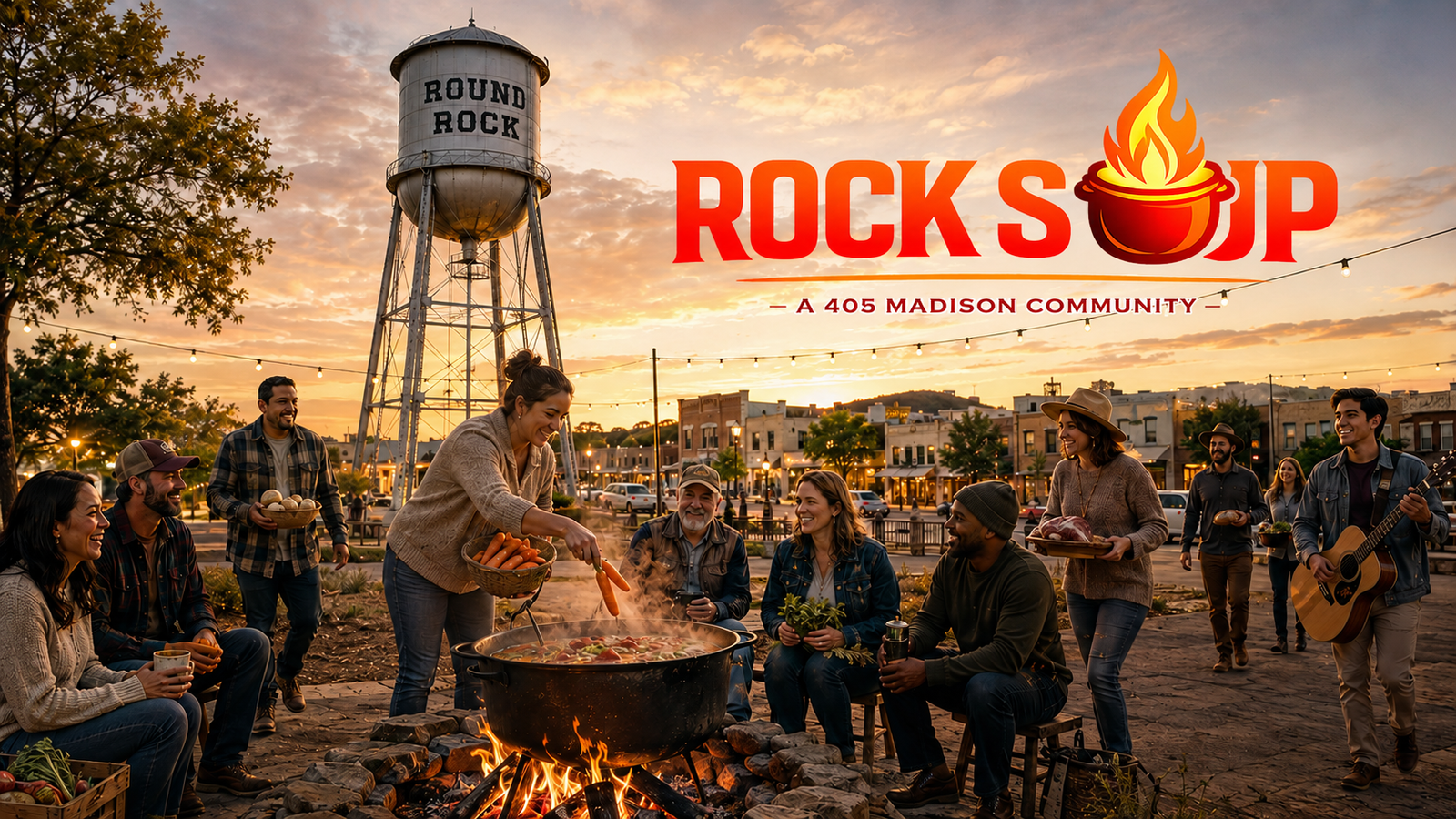
Firehouse is the pot. 405 Madison tends the fire.
The neighborhood brings the ingredients.
Every Friday, a local business owner joins us to make a pot of soup, tell the real story behind their business, and share it with the people who make this community work.
A hungry traveler arrives in a village and asks for something to eat. The villagers turn them away. One says there is no bread. Another says there is no meat. Another says there is barely enough food for their own family.
So the traveler places a stone in a pot of water, lights a fire beneath it, and announces that they are making stone soup. The villagers are curious. The traveler tastes the water and says: "It is almost ready. It would be even better with an onion."
One villager has an onion. Another brings carrots. Someone finds a few potatoes. Someone else adds meat. Another brings herbs, salt, and seasoning. A baker arrives with bread. One by one, the people who believed they had nothing discover that each of them has something worth contributing.
No individual person had enough to feed the village. Together, they had more than enough. The stone did not make the soup. The community did.
That is Rock Soup.
Every business has an ingredient. A skill. A customer. A connection. A piece of equipment. An hour of time. A lesson learned the hard way. An opportunity someone else has been looking for.
One contribution may not seem like much by itself. But when the right people gather around the same pot, small contributions become real work, new customers, stronger businesses, better jobs, and opportunities that remain in the community.
Firehouse Studios is the pot. 405 Madison tends the fire. Everyone who shows up brings an ingredient.
For most of human history, a community was more than a collection of people living near one another. It was an economic system.
The farmer grew the food. The butcher prepared it. The grocer sold it. The restaurant cooked it. The family carried it home and placed dinner on the table.
But the relationships did not stop there. The mechanic kept the farmer's truck running. The carpenter built the butcher's shop. The banker knew the grocer. The restaurant hired the baker's daughter. A young worker learned a trade from someone who had spent a lifetime mastering it.
People knew who did good work. They knew who could be trusted. They knew who needed help, who was ready for an opportunity, and who deserved a second chance. Money moved through the community, but so did knowledge, responsibility, ownership, reputation, and trust.
A person did not have to introduce themselves as part of a "network." They were already part of one.
Then the pieces moved apart. The farmer became disconnected from the grocer. The employer became disconnected from the worker. The customer became disconnected from the person doing the work.
Local businesses became dependent on distant platforms to reach people living only a few miles away. Skilled workers began sending résumés into systems that never allowed anyone to know them. Owners who spent decades building good companies reached retirement without anyone prepared to carry those businesses forward.
We gained speed, scale, and convenience. But we lost proximity — the natural places where people repeatedly encountered one another, built reputations, exchanged knowledge, and developed trust before they needed something.
We did not stop having ingredients. We stopped gathering around the same pot.
Small businesses still account for roughly half of all economic activity and employment in this country. But the people behind those businesses are increasingly separated from their customers, from other local businesses, from skilled workers, from future owners, and from the communities around them.
The larger issue isn't merely the separation of wealth. It's the separation of wealth, work, ownership, and opportunity.
Local money is increasingly extracted through national platforms, distant corporations, franchise structures, advertising systems, and private-equity ownership. The local business produces the value. The community creates the demand. But the wealth often leaves both.
Many of the people we're talking about are technically employed — consulting, doing gig work, or actively looking. The deeper problem is that their experience no longer connects cleanly to available opportunity.
White-collar layoffs. Automation and outsourcing. Corporate restructuring. Older Millennials and Generation X being displaced. Experienced people being told to "learn a trade" while skilled-trade shortages exist alongside experienced people who can't find a path into those trades. Résumés disappearing into online systems. Local employers saying they can't find reliable people.
A 52-year-old project manager with a mortgage, children, and twenty-five years of experience cannot solve the problem by watching a video about underwater welding and reporting to the ocean Monday morning.
The point isn't that people can't change careers. The point is that career transitions require a real person, a real opportunity, training, trust, mentorship, and a path into paid work. Those paths used to come through community.
While experienced people struggle to find their next chapter, thousands of established local owners are reaching retirement with no succession plan, no family member who wants the business, no employee prepared to buy it, no relationship with a future owner, and a company too small for institutional buyers.
A profitable business can disappear without ever failing.
Meanwhile, someone nearby may have the experience to operate it — but no idea the opportunity exists. The future worker, manager, partner, apprentice, or owner may already live within ten miles. The problem is that no room exists where they can meet and build trust.
We're not pretending everything was better fifty years ago. We're recovering the part that worked: people knew one another, reputation mattered, skills were visible, opportunities moved through relationships, and trust was built before it was needed.
Proximity creates familiarity. Familiarity creates trust. Trust creates opportunity. Repeated opportunity builds community wealth.
The solution is not another networking app. It is not another paid referral club. It is not another résumé platform. It is rebuilding the room where the right people can repeatedly encounter one another.
Every Friday, a local business owner joins us in the Firehouse kitchen. We cook a pot of soup while telling the real story behind the business — how it began, what nearly stopped it, what it needs, and how it can help.
The owner invites their staff, clients, family, and friends. Rock Soup invites the neighborhood. At five, the doors open and everyone shares the meal.
The guest brings the story. The neighborhood brings the people. Everyone brings something. Together, we feed the room.
When a customer needs something you don't provide, introduce them to someone whose hand you've shaken and whose story you know.
When a business needs help, or a talented person needs a new path, connect ability with opportunity.
Help businesses survive, grow, transfer knowledge, and eventually pass into the hands of the next owner.
Loading...
Loading...
Loading...
A local business owner joins us in the Firehouse kitchen. We make soup and record the honest story behind the business.
The guest's staff joins us, the neighborhood arrives, and the soup is served.
No forced elevator pitches. No one-business-per-category rule. No national dues. Just a standing invitation for the people who work, build, cook, create, hire, and serve in this community to actually know one another.
RSVP for FridayWhy Rock Soup exists and what we're rebuilding.
A one-page explanation for staff, clients, and neighbors.
A practical check of whether customers can find, understand, and trust your business.
A simple tool for making a useful introduction.
Companion material from the weekly training.
Approved logo files, graphics, and event material.
One business was asked for something it did not provide. Instead of saying no or sending a random phone number, the owner introduced the customer to someone already trusted from Friday night. The customer got help, two businesses strengthened their relationship, and the opportunity stayed in the neighborhood.
The featured business brings its people. We invite the neighborhood.
The pot is on at four. Dinner is ready at five.